
An interdisciplinary research team has uncovered a new explanation for the foraging division of labor in bumblebees, drawing on insights from fluid dynamics, morphology, and ecology. Their study reveals that subtle variations in the microstructure of the insects' functional organs can shape labor division at the colony level.
The team, consisting of scientists from the Nanjing Institute of Geology and Palaeontology of the Chinese Academy of Sciences (NIGPAS), Sun Yat-sen University, and Beijing Institute of Technology, recently published their findings in Proceedings of the National Academy of Sciences (PNAS).
Bumblebees have evolved a specialized mouthpart: the glossa. When gathering nectar, this tongue-like structure moves rapidly back and forth to trap and transport nectar into the mouth. Dotted with thousands of fine hairs, the glossa deploys these filaments as it extends—a key adaptation for efficient nectar collection.
Using scanning electron microscopy, the team conducted detailed morphological analyses of the glossa. Dissections of 99 bumblebees showed that glossa length ranges from approximately four to ten millimeters. Larger bumblebees were found to have longer glossae with wider spacing between the hairs.
Notably, the queen—the largest and highest-ranking member of the colony, representing the extreme end of the species' morphological spectrum—exhibits a consistent hair spacing of 40–50 micrometers regardless of body size. In contrast, worker bees display hair spacing that varies from 15 to 45 micrometers, correlating directly with their body size.
To simulate natural foraging conditions, the researchers prepared sucrose solutions of varying concentrations to mimic nectar, then injected the solutions into one-millimeter-diameter glass capillaries to replicate flower corollas. Using high-speed microphotography, they quantified the volume of nectar ingested with each glossa movement.
The results showed that while larger bumblebees generally ingest more nectar per glossa stroke, this volume increase lags far behind the expansion of the glossa's internal available space relative to body size. In short, bigger bees do not achieve proportionally higher effective intake. Even when queens are similar in size to workers, their wider hair spacing results in lower glossa nectar fill rates than their worker counterparts. Collectively, the data indicate that larger bumblebees with wider hair spacing struggle to fully utilize the glossa's internal volume for nectar storage.
Furthermore, high-speed microimaging revealed that as the glossa retracts, adjacent hairs form curved air-liquid interfaces. These interfaces generate an additional capillary pressure gradient that boosts the entrainment of viscous nectar, balancing hydrostatic pressure in the process. However, wider hair spacing or increased glossa length diminishes the structure's liquid-carrying capacity.
Beyond surface tension, viscosity also plays a pivotal role in nectar capture. The team found that due to structural constraints on glossa growth, larger bumblebees' mouthparts fail to maintain an optimal scaling relationship with body size under natural conditions. This imbalance allows gravity to dominate, reducing the glossa's nectar fill rate.
By integrating multidisciplinary evidence, the study deciphers the allometric growth pattern of the bumblebee glossa. This scaling relationship, which lowers nectar fill efficiency, physically restricts the foraging capability of larger bumblebees.
This work was funded by the National Natural Science Foundation of China.
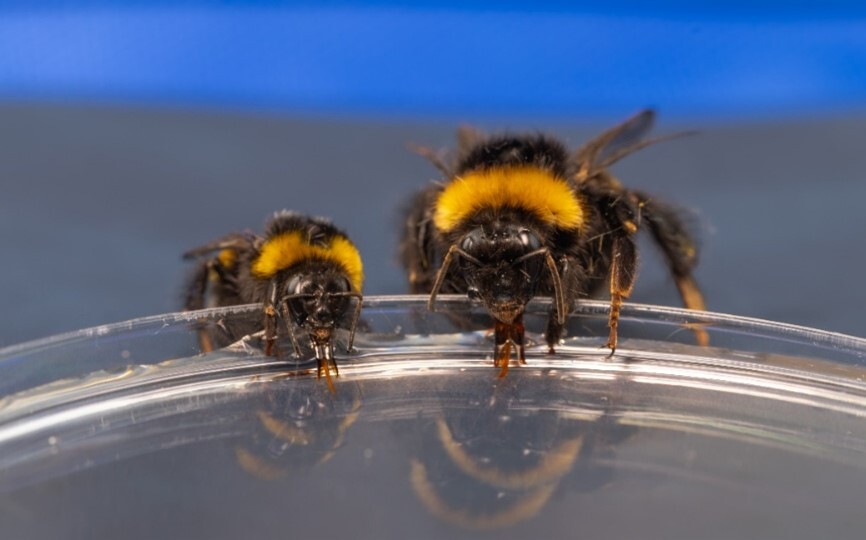
Bumblebee worker (left) and queen (right) feeding on artificial nectar in the laboratory. (Image by NIGPAS)

86-10-68597521 (day)
86-10-68597289 (night)

52 Sanlihe Rd., Xicheng District,
Beijing, China (100864)
Copyright © 2002 - Chinese Academy of Sciences


